 EN
EN
 AR
AR
 NL
NL
 FI
FI
 FR
FR
 DE
DE
 EL
EL
 HI
HI
 IT
IT
 JA
JA
 KO
KO
 PT
PT
 ES
ES
 RU
RU
 TL
TL
 ID
ID
 UK
UK
 VI
VI
 TH
TH
 HU
HU
 TR
TR
 MS
MS
 LA
LA
 BN
BN
 MN
MN
 MY
MY
 UZ
UZ
 KK
KK


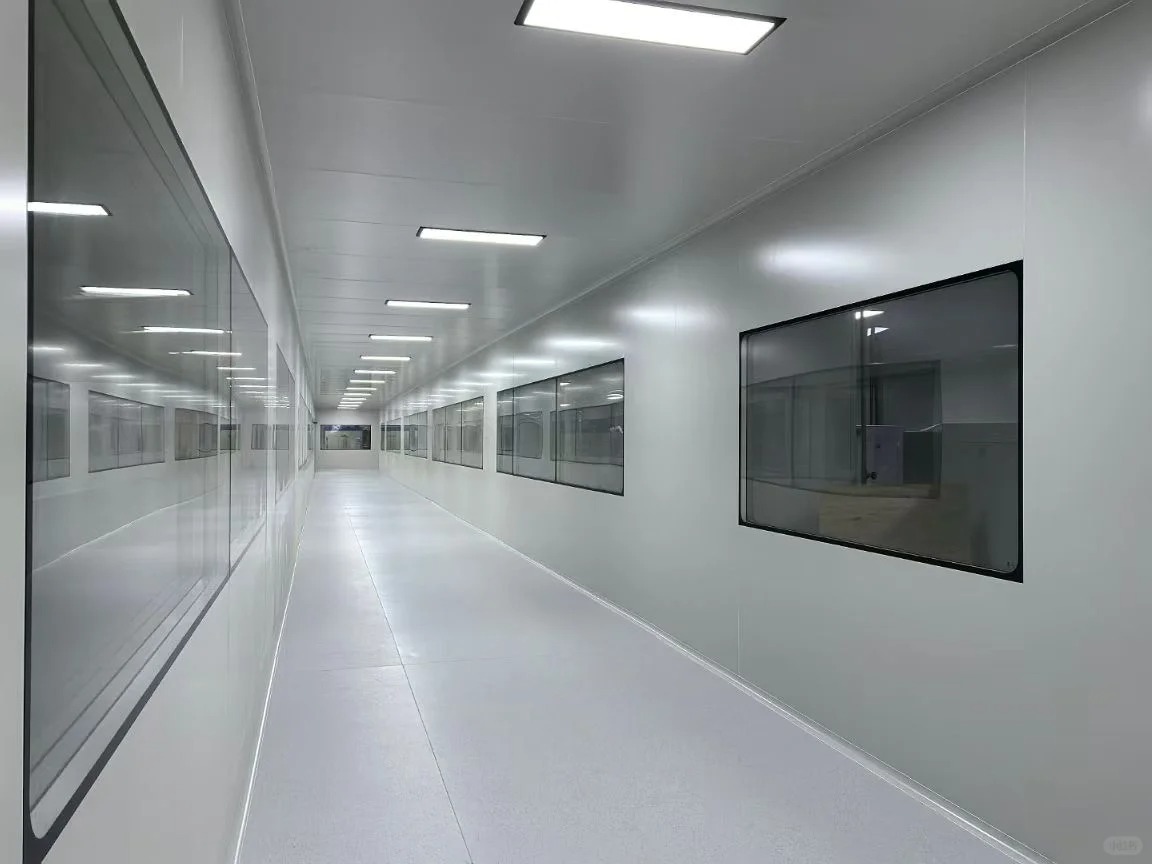
The basic principle of the contamination control on FFU (Fan Filter Unit) cleanroom is laminar flow. It might be a pharmaceutical filling line, a semiconductor wafer stepper or a hospital operating table; the airflow is always from the critical area to where the particles are being removed. However, laminar flow is susceptible. It may be disturbed by any irregularity, pressure or temperature difference on the surface. Windows are considered a passive architectural element, but they are actually impacting the laminar flow performance and it's measurable. There are four ways that windows impact laminar flow in FFU cleanrooms.
1. Surface Protrusions Create Turbulent Wakes
The physical profile is the first impact that a window has on laminar flow. The "gap" between traditional windows and their frames, and between the handles/sills and the window is 10-30 mm out-of-plane. The airflow generated by the FFU is directed downward (typical airflow 0.3 to 0.5 m/s in ISO Class 5 cleanrooms) and comes in contact with this protrusion and separates from the wall. Downstream from the obstacle a turbulent wake is created of the height 10-20 times the obstacle. The extent of the turbulent zone, for a protruding frame of 20 mm, is between 200 mm and 400 mm from the wall.
With "flush mounted" windows, this can be eliminated. Huaao clean room windows are made to be sandwiched into the clean room window. The frame is hidden behind the glass plane and there are no handles. CFD simulations reveal that the velocity difference between the wall and window boundary is less than 5% at Huaao's flush mounted windows, less than 20-30% for conventional windows. This difference will have a direct impact on the number of particles that form at the surgical field in laminar-flow critical environments such as hospital operating rooms.
2. Surface Roughness Disrupts the Boundary Layer
If the window frame is not a protrusion, the laminar flow will still be affected by the surface texture of the window frame and glass. Laminar boundary layers are extremely thin layers and for a clean area, they are only a few mm thick. Surface roughness higher than the boundary layer thickness can cause the flow to become turbulent.
Huaao's production of window frames is based on the material of the powder-coated aluminum whose surface finishing is less than 0.8 micro-meter. Glass is smooth float glass and has optical qualities. All frame to glass joints are continuous (no steps or gaps). This level of finishing will ensure laminar flow and boundary layer on the entire surface area of the wall. The roughness on the surface is a very important consideration in particle counting cleanrooms, especially in the ISO Class 4 and ISO Class 5 clean rooms.
3. Air Leakage Bypasses FFU Filtration
Pressure integrity is important and so is smooth air flow to laminar air flow. The air leakage specification for typical medium quality windows is 1 m³/h at 50 Pa. If a window leaks 1 m³/h/PAS, air will be allowed to enter the clean room, which will not be filtered. This is bypass air with particles that are not removed by the FFUs resulting in high particle contamination areas.
Huaao's all windows and glass panels are air tested in accordance with GB/T 7106 and ISO 13830. In our windows we use closed-cell EPDM or silicone gaskets and multi-point compression locks which ensure that the air leakage rate is less than 0.5 m³/h at 50 Pa. For critical applications a double-seal configuration is also available including an optional testable cavity to allow testing of seal integrity without breaking window. Huaao windows can prevent leakage to ensure that the air in the cleanroom goes through the FFU HEPA filters.
4. Temperature Gradients Cause Localized Buildup
Another effect of buoyancy is on the flow of an ideal gas in a steady manner. If the temperature of one surface of the window is very high or low compared to the temperature of the room, natural convection currents are set up. The currents are in opposite direction of the downward current due to the FFU, and provide regions of particle "settling" as recirculation zones.
Huaao's clean room windows are double or triple glazed with argon or krypton gas filling. Cold bridging is prevented with the inclusion of thermal breaks in the frames. The thermal properties are especially beneficial in hospital cleanrooms where they are used in the exterior wall or in pharmaceutical cleanrooms where they have to be precisely controlled within a restricted temperature window, usually ±0.5°C. This yields a laminar flow field which is uniform and predictable.
Summary
Surface protrusions, generating turbulent wakes, surface roughness, disturbing the boundary layer, leakage around FFUs, bypassing the filter and temperature difference creating buoyancy-driven recirculation are the four mechanisms that have impact on laminar flow in FFU clean rooms. The problems are solved by cleanroom windows produced by the national high-tech group, Huaao Clean Technology Group, which has 6 factories, a production line area of 250,000 m², 800 experienced employees and an annual turnover of 1 billion RMB. The complete modular cleanroom one-stop system covers cleanroom panels, doors and windows, aluminum profiles, PVC flooring, purification equipment, shadowless lamps, ventilation valves, etc., all of which are provided by Huaao. Call Huaao now and have your FFU cleanroom windows not disrupt, but help to create laminar flow.
