

A cleanroom pass box looks simple on a floor plan: a rectangle through a wall with one door on each side.
That apparent simplicity is why specifications are often incomplete.
A typical inquiry might say, “Need 10 stainless-steel pass boxes, 600 × 600 × 600 mm.” It gives a quantity, material and nominal size, but it does not tell the manufacturer what is being transferred, which dimension refers to the internal chamber, how thick the wall is, how the two doors should interlock, or whether the equipment must interface with an existing modular wall system.
Those omissions become expensive after wall panels have been fabricated.
For an RFQ that suppliers can quote consistently, define the transfer process first and the equipment dimensions second.
Start with the transferred item.
A box used for laboratory samples does not necessarily need the same usable chamber as one transferring sealed production components, instrument trays or packaged consumables.
The RFQ should therefore state:
This immediately gives the supplier better information than simply asking for a “standard pass box.”
Internal chamber dimensions should leave practical clearance around the transferred item. At the same time, unnecessarily oversizing the chamber increases the wall opening and can complicate installation.
For projects still at design stage, use the largest expected transfer item as one input to chamber sizing rather than copying a dimension from another facility.
A dimension such as 600 × 600 × 600 mm can describe three different things:
Internal chamber dimensions — usable transfer space.
External equipment dimensions — the overall manufactured unit.
Reserved wall opening — the opening required for installation.
They are not interchangeable.
A procurement schedule should use separate fields:
Internal Chamber W × H × D
Overall Equipment W × H × D
Required Wall Opening W × H
Wall Thickness
Installation Height
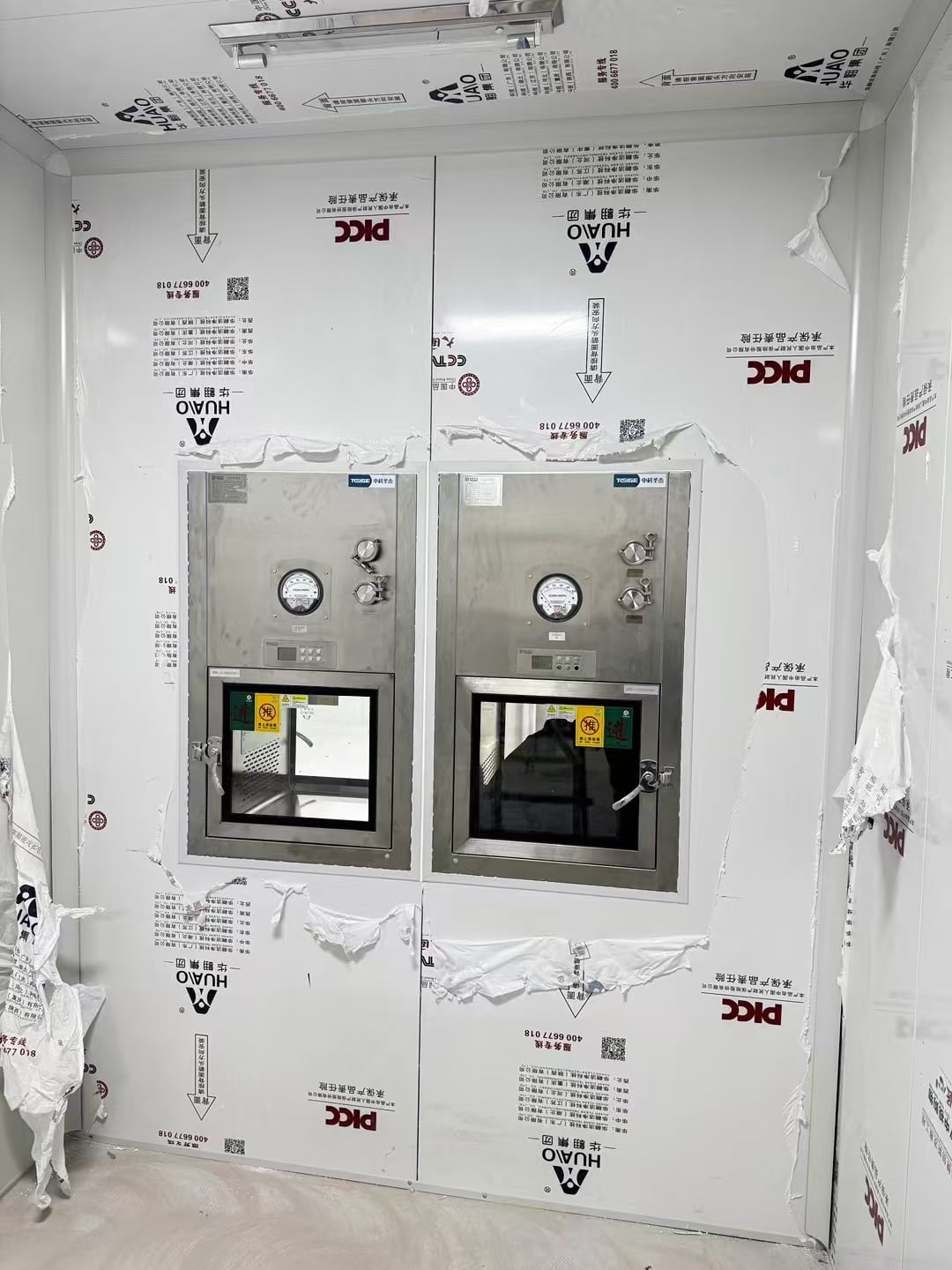
This distinction becomes particularly important when a cleanroom pass box is installed in modular sandwich panels.
The wall-panel manufacturer needs the reserved opening.
The equipment supplier needs the wall construction and thickness.
The user needs enough internal space for the intended transfer.
One number cannot reliably serve all three parties.
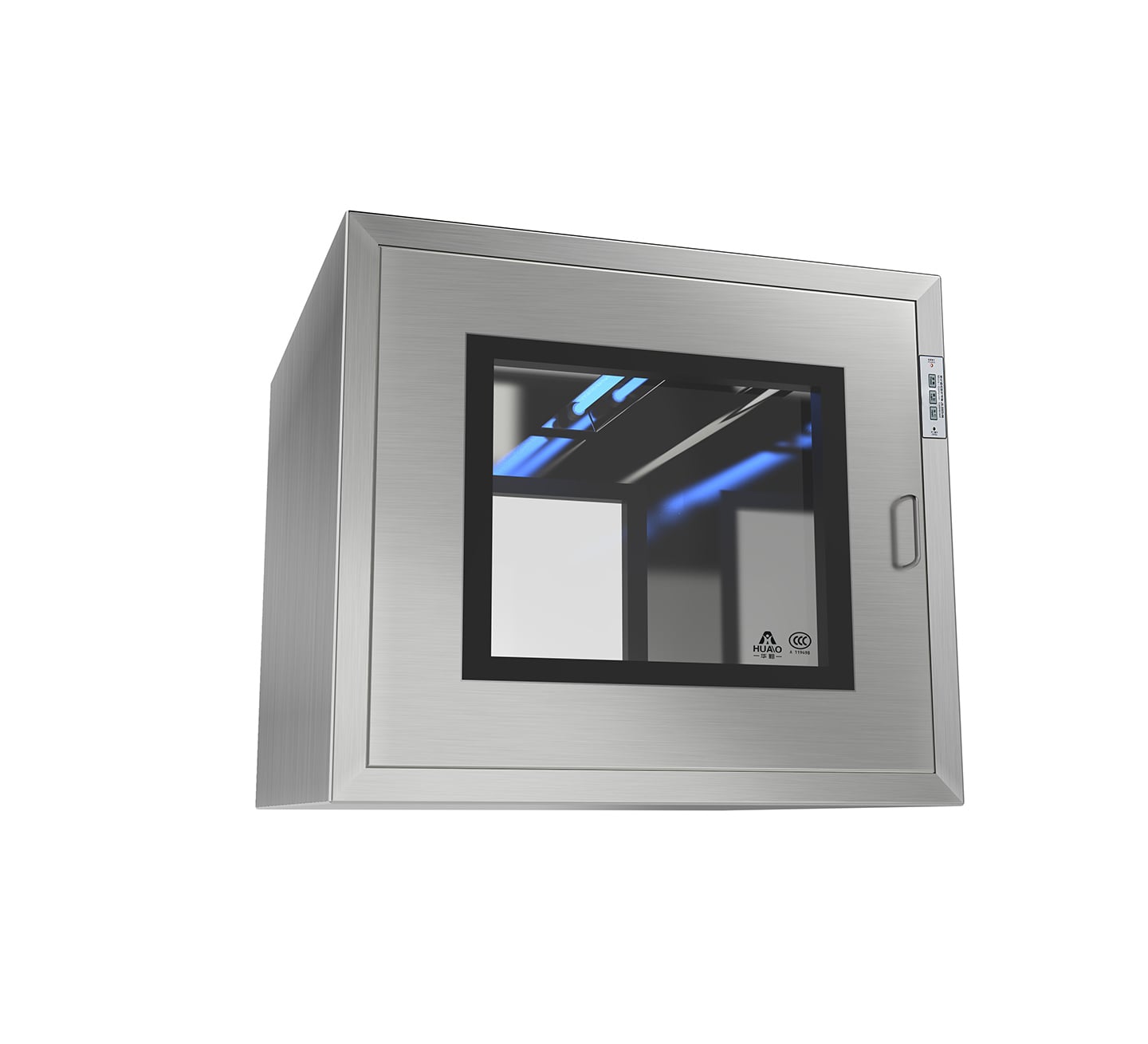
HUAAO's documented pass-box description confirms double-door interlocking and states that electronic or mechanical interlocking devices can be used. 华翱洁净产品系列画册英文版
For a project RFQ, however, the word interlock is still incomplete.
The buyer should understand the intended operating sequence.
For a basic transfer:
The key principle is that the transfer device should support the project's contamination-control procedure rather than allow both sides to be casually opened at the same time.
Ask the supplier to explain:
Do not assume that every pass box uses the same control sequence.
The wall interface deserves its own drawing.
A pass box installed through a modular cleanroom wall affects the panel opening, reinforcement, trim, sealing and sometimes adjacent aluminum profiles.
Before fabrication, confirm:
A common coordination problem occurs when the equipment schedule is updated after the wall-panel production drawings have already been approved.
The pass box becomes slightly larger.
The panel opening remains unchanged.
The correction then moves from factory production to site cutting.
That is precisely the type of avoidable interface issue an RFQ should prevent.
Where possible, include a wall elevation rather than only a floor plan.
Not every material transfer requires the same equipment concept.
A basic pass box relies primarily on a controlled transfer sequence and door separation.
Other applications may require an actively ventilated or filtered transfer arrangement.
The decision should come from the contamination-control strategy and process risk—not from a sales catalogue.
Ask:
What contamination risk does the transferred item create?
Are the two rooms at different cleanliness levels?
Is there a pressure relationship that must be protected?
Does the project specification require active airflow or filtration?
Is decontamination part of the transfer procedure?
If the process requires airflow, filtration or pressure-related functionality, those requirements should be written explicitly into the equipment specification.
Do not assume that a standard static pass box provides those functions merely because it is installed in a cleanroom wall.
HUAAO's available catalogue confirms its documented pass-box construction and interlocking features, but the current extract is not sufficient to claim a universal dynamic-pass-box configuration.
That distinction should remain clear in published content and quotations.
HUAAO's catalogue states that the documented pass-box configuration is equipped with ultraviolet disinfection lamps. 华翱洁净产品系列画册英文版
That supports a product-feature statement.
It does not justify a blanket claim that every transferred item becomes sterile.
UV effectiveness depends on factors such as exposure conditions, shadowing, distance, lamp output, microorganisms and the validated process.
For procurement, ask more practical questions:
If the project requires a quantified microbial reduction or validated disinfection process, that requirement needs separate technical evidence.
The phrase “UV lamp included” is not a substitute for process validation.
The interior is touched by transferred objects repeatedly.
That makes cleaning access more important than decorative appearance.
HUAAO's catalogue describes stainless-steel plate construction with a smooth, clean internal surface for the documented pass box. 华翱洁净产品系列画册英文版
For the actual project, review:
If a removable tray or shelf is required, specify it.
If cleaning chemicals are defined by the facility, give that information to the supplier and request compatibility confirmation for the proposed material and seals.
A generic phrase such as “easy to clean” is less useful than describing how the facility actually cleans the equipment.
A purely mechanical interlock may have different electrical requirements from an electronically interlocked unit with UV, indicators or controls.
Therefore, the RFQ should include:
Project Voltage
Frequency
Phase
Interlock Type
UV Requirement
Status Indicator
Alarm/Buzzer Requirement
Building Control Interface, if required
If no external control integration is needed, say so.
If integration is required, define the interface.
This avoids a familiar commissioning problem: the equipment arrives with a local controller while the contractor expected status signals for a centralized system.
The manufacturer should not infer building-management-system integration from the words “electronic interlock.”
A compact schedule can remove most quotation ambiguity:
| RFQ Field | Project Information |
|---|---|
| Pass Box ID | PB-01 |
| Room From / To | Define both rooms |
| Quantity | Units |
| Transfer Item | Description |
| Max. Item Size | W × H × D |
| Internal Chamber | Required / supplier proposal |
| Overall Size | Supplier proposal |
| Reserved Opening | Confirmed / TBC |
| Wall Thickness | mm |
| Installation Height | mm |
| Construction | Project requirement |
| Interlock | Mechanical / electronic / TBC |
| UV | Required / not required |
| Power Supply | Project data |
| Shelves | Required / none |
| Control Interface | Requirement / none |
| Cleaning Requirement | Facility procedure |
| Documentation | Datasheet / drawings / test evidence |
| Status | Approved / Coordination / TBC |
When quotations return, compare the scope line by line.
One supplier may include electronic interlocking and UV.
Another may quote a mechanical unit.
A third may exclude installation trims or wall closure.
Those are not equal bids even if all three quotations use the same nominal chamber dimensions.
The best cleanroom pass box RFQ therefore begins with the transfer process, then locks down the chamber, wall, door logic and control interfaces before commercial comparison.
Provide the transfer item, quantity, required chamber size, wall thickness, reserved opening, installation height, interlock requirement, construction material, electrical supply and any UV or control requirements.
The chamber size describes usable transfer space. Overall size includes the equipment casing and structure. The wall opening is a third dimension that should be confirmed separately.
Interlocking is commonly used to control the transfer sequence. HUAAO's documented pass box uses double-door interlocking with electronic or mechanical interlock options. 华翱洁净产品系列画册英文版
A UV lamp is a component, not proof of a validated sterilization result. Any required microbial reduction or sterilization performance should be supported by an appropriate validated process and technical evidence.
The equipment dimensions and reserved wall opening should ideally be coordinated before wall-panel fabrication. This reduces the risk of site cutting and mismatched openings.
 EN
EN
 AR
AR
 NL
NL
 FI
FI
 FR
FR
 DE
DE
 EL
EL
 HI
HI
 IT
IT
 JA
JA
 KO
KO
 PT
PT
 ES
ES
 RU
RU
 TL
TL
 ID
ID
 UK
UK
 VI
VI
 TH
TH
 HU
HU
 TR
TR
 MS
MS
 LA
LA
 BN
BN
 MN
MN
 MY
MY
 UZ
UZ
 KK
KK

