

A hospital renovation contractor may receive a flooring delivery while the concrete substrate still looks perfectly dry.
The surface is smooth. No standing water is visible. The installation team is ready.
But the appearance of concrete does not establish whether it is suitable for adhesive installation.
Hospital PVC flooring moisture tests are therefore an important part of the pre-installation review, particularly where resilient flooring will be bonded to concrete.
The issue is not simply whether the concrete has dried for a certain number of days. The relevant questions concern moisture conditions, substrate preparation, adhesive compatibility and the acceptance criteria specified for the selected flooring system.
For hospital contractors, these checks should be completed before installation begins—not reconstructed after a flooring defect appears.
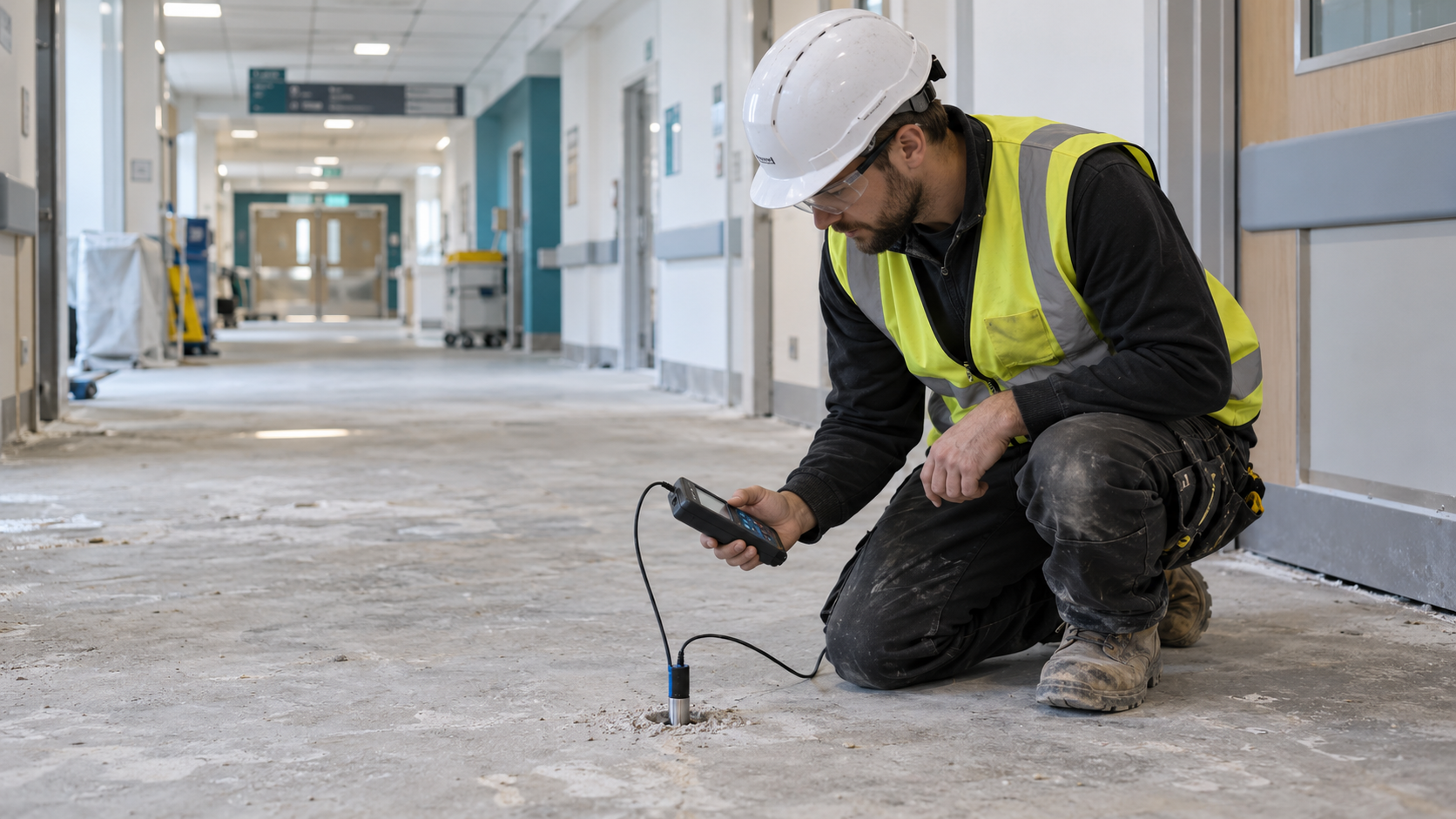
Concrete can contain moisture even when its surface appears dry.
The moisture condition of the slab may affect the performance of certain adhesives and flooring assemblies.
If the selected system is installed outside its approved conditions, problems may develop after the area enters service.
These problems can include loss of adhesion, localized lifting or other installation defects.
However, the presence of moisture does not automatically mean that every PVC flooring system will fail.
The result depends on the flooring product, adhesive, substrate and installation conditions.
Visual inspection remains useful.
It can identify standing water, cracks, contamination and damaged surfaces.
But it cannot provide a quantitative measurement of moisture inside the concrete.
A contractor should not approve a substrate merely because it looks dry.
A newly constructed slab may require time before receiving resilient flooring.
Nevertheless, a fixed waiting period does not establish the actual moisture condition.
Drying is influenced by slab construction, environmental conditions and other project variables.
An older slab may also require testing, particularly during renovation.
ASTM F710-26 calls for moisture testing of concrete slabs before resilient flooring installation, regardless of slab age or grade level. ASTM Store
A moisture measurement becomes useful only when it can be compared with an applicable acceptance requirement.
That requirement should be confirmed for the selected flooring and adhesive system.
An isolated test result without an approved limit does not establish whether installation may proceed.
Several methods may be encountered in flooring specifications.
They do not necessarily measure the same property.
The project team should identify the required method before arranging testing.
ASTM F2170 describes the determination of relative humidity within concrete slabs using in-situ probes.
The result is expressed as a percentage of relative humidity.
The test provides information about the internal moisture condition at the measured locations.
It does not directly measure adhesive strength or guarantee the future performance of a flooring installation.
The applicable acceptance limit must come from the approved flooring system requirements.
Handheld moisture meters may be useful for preliminary investigation.
They can help identify areas requiring further attention.
However, their readings should not automatically replace the specified quantitative test.
The equipment's intended application and the project specification must be considered.
Some projects may specify a moisture vapor emission test.
This method assesses a different moisture-related property from internal relative humidity.
Results from different methods should not be treated as interchangeable.
For example, a relative humidity percentage cannot be converted into a moisture vapor emission rate using a universal conversion factor.
A practical sequence is to identify the flooring system, obtain its installation requirements and confirm the accepted test method.
Only then should the contractor establish the testing plan.
This avoids collecting results that cannot be used for approval.
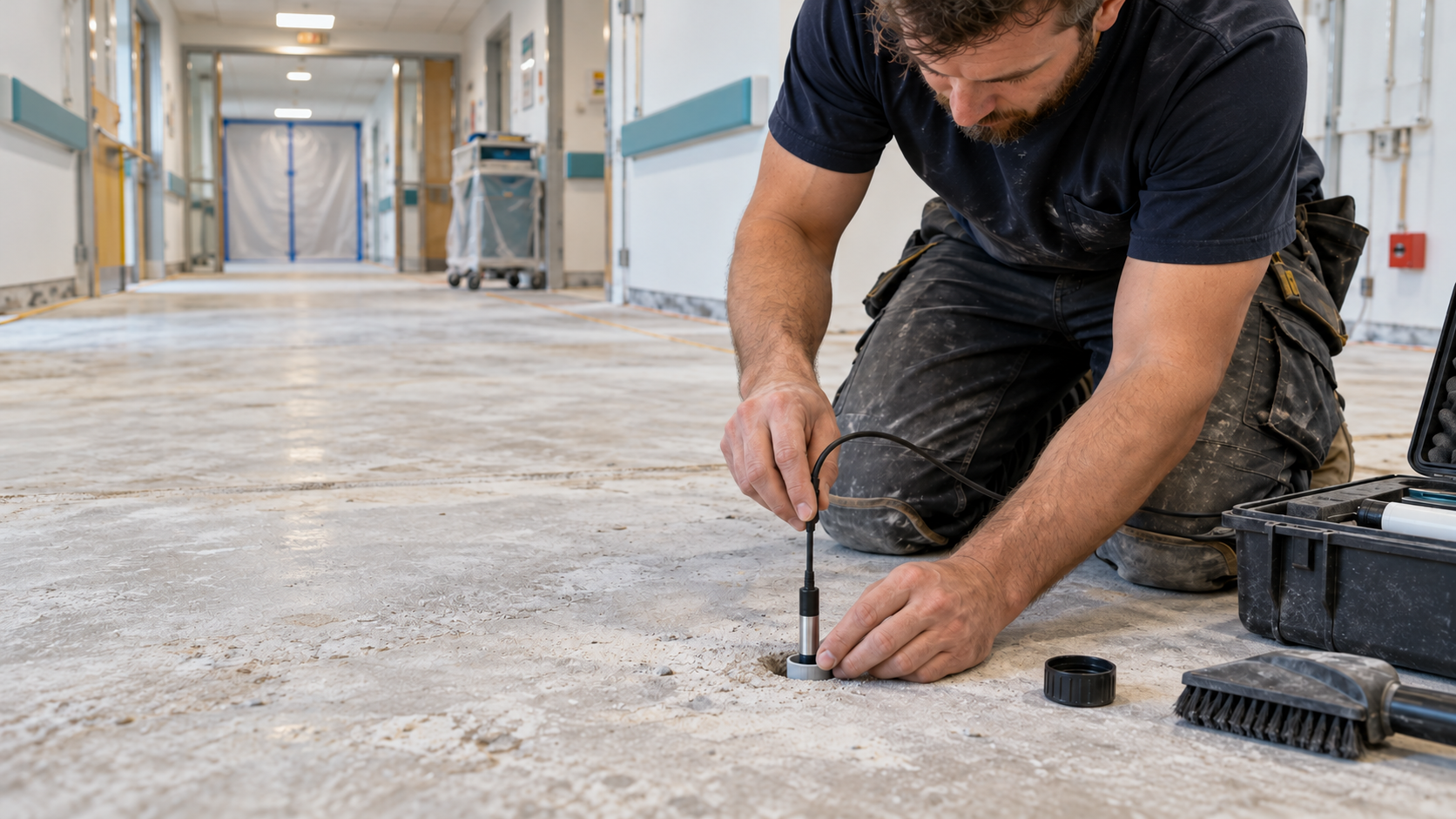
A hospital project may include corridors, patient rooms, treatment areas and service spaces.
Testing one convenient location does not necessarily represent every area.
The testing plan should consider the actual construction conditions.
Different building sections may have different concrete histories.
For example, a newly constructed wing and an existing hospital corridor may require separate evaluation.
The same applies where different slab constructions or environmental conditions are present.
The testing plan should identify these differences.
Every measurement should be traceable to a specific position.
A useful record includes the building, floor, room number, test location and date.
The contractor should also record the test method and equipment identification.
Where the applicable procedure requires calibration or equilibration records, these should be retained.
The number and distribution of tests should follow the applicable standard, flooring manufacturer's instructions and project specification.
A contractor should not invent a universal number of tests per room.
Large areas and irregular construction conditions may require additional investigation.
A simple floor plan showing test positions is valuable.
It allows the owner, contractor and flooring supplier to identify which areas were tested.
If a defect appears later, the original test locations can be compared with the affected area.
This provides stronger evidence than a report stating only that the floor was dry.
Moisture is not the only substrate condition relevant to resilient flooring.
Concrete surface alkalinity can also matter for some adhesive and flooring systems.
ASTM F710-26 addresses pH testing as part of concrete substrate preparation. ASTM Store
A moisture test does not determine concrete pH.
Likewise, a pH measurement does not establish the internal moisture condition.
Both may be required.
The project team should confirm the applicable methods and limits.
It is tempting to specify a single acceptable pH range for every flooring project.
That approach can be misleading.
Different adhesive systems may have different requirements.
The approved installation instructions should govern the acceptance decision.
Before testing, the contractor should review the surface preparation requirements.
Residual contaminants, previous treatments and construction materials may affect the condition being assessed.
The testing procedure should be performed according to the relevant standard.
Results obtained using an unsuitable method should not be used to authorize installation.
A satisfactory moisture result does not mean the concrete is ready for flooring.
Other conditions can affect installation quality.
The substrate should be structurally suitable for the intended flooring installation.
Weak surface layers, damaged concrete and unstable repair areas may require corrective work.
The flooring contractor should not assume responsibility for structural defects outside the flooring scope without an agreed repair procedure.
Resilient flooring can reveal irregularities in the underlying surface.
Depressions, ridges and poorly finished repairs may become visible after installation.
The applicable flatness or smoothness requirement should be defined by the project and product instructions.
Oil, dust, curing compounds and other residues may interfere with adhesive bonding.
Cleaning and preparation should follow the approved method.
Simply covering contamination with an additional adhesive layer is not a reliable correction.
The contractor should distinguish between different types of cracks and joints.
Some may be suitable for approved preparation or repair.
Others may require movement accommodation or additional engineering review.
A flooring installation should not be used to conceal an unresolved structural movement problem.
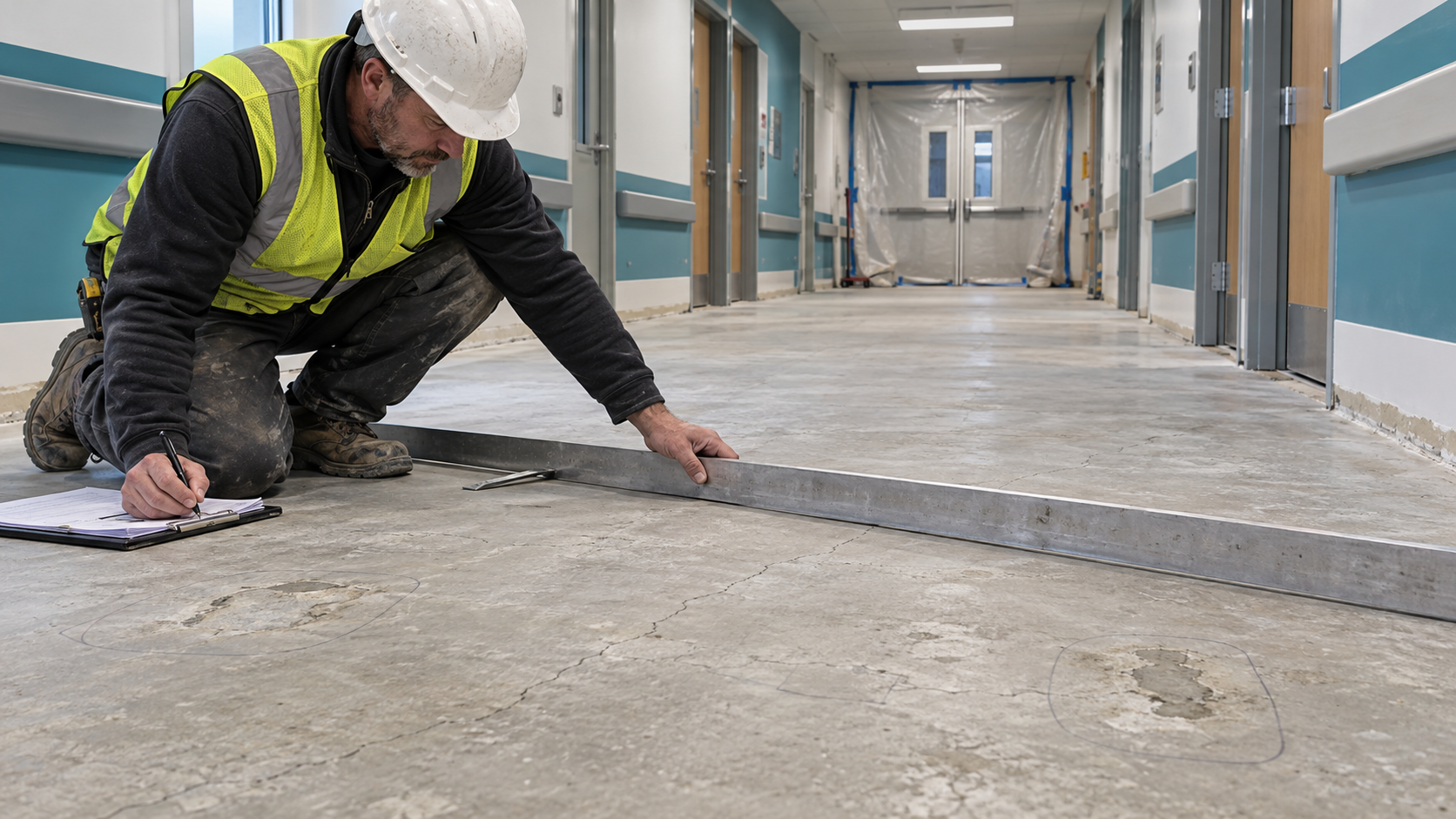
An unacceptable test result should trigger a documented review.
It should not automatically lead to changing the test method until a more favorable number appears.
Where the results do not meet the approved criteria, installation should not proceed without an accepted technical resolution.
The decision should identify the affected rooms or zones.
This prevents a localized issue from unnecessarily delaying unrelated areas.
The project team should consider whether the moisture condition is related to construction drying, environmental conditions or an ongoing source of water.
A persistent water source requires a different response from a slab that is still drying.
The investigation may involve the general contractor, flooring specialist and building engineer.
Depending on the circumstances, possible approaches may include additional drying time, substrate correction or a compatible moisture-mitigation system.
These options are not interchangeable.
A mitigation product should be evaluated as part of the complete flooring assembly.
Its compatibility with the selected adhesive and flooring must be confirmed.
After corrective work, the project may require further testing.
The results should be compared with the approved acceptance criteria.
The contractor should retain both the original failed results and subsequent records.
Deleting unsuccessful test results weakens the project's quality documentation.
A useful approval record connects the substrate condition with the specific flooring system.
The following checklist provides a practical starting point.
| Inspection Item | Required Information |
| Project location | Hospital and building |
| Room identification | Room number or zone |
| Substrate type | Concrete construction |
| Flooring product | Approved manufacturer and reference |
| Adhesive | Approved product and reference |
| Test method | Applicable standard |
| Test location | Marked on drawing |
| Test date | Recorded date |
| Relative humidity | Measured result, where applicable |
| Moisture acceptance limit | Approved system requirement |
| pH test | Method and result |
| Surface condition | Inspection record |
| Flatness | Approved acceptance criteria |
| Repairs | Completed or outstanding |
| Environmental conditions | Required installation conditions |
| Approval authority | Responsible person |
| Installation status | Approved / Hold / TBC |
The person performing the test may not be authorized to approve the installation.
The contract should identify who reviews the results and releases the area for flooring work.
This avoids disputes when the installer, general contractor and owner have different interpretations of the test report.
A substrate may be acceptable for one flooring system but not another.
If the flooring or adhesive changes, the acceptance decision may need to be reviewed.
Do not assume that approval remains valid after a material substitution.
The final project documentation should include the approved test results and any corrective actions.
These records are useful during handover and future defect investigation.
They also help distinguish substrate-related issues from damage occurring after occupancy.
Hospital PVC flooring moisture tests are most valuable when they form part of a documented pre-installation decision.
The objective is not to collect as many measurements as possible. It is to establish whether the actual substrate meets the requirements of the selected flooring system before installation begins.
Older concrete may still require moisture testing. The applicable standard, project specification and flooring manufacturer's instructions should determine the testing requirements.
There is no universal acceptance value for every product. The limit must be confirmed for the selected flooring and adhesive system.
A handheld meter may help with preliminary investigation, but it should not replace a specified test unless the approved requirements permit that method.
Surface alkalinity can affect the compatibility of some adhesive and flooring systems. The required test method and acceptance range should follow the approved product instructions.
Hold installation in the affected area, investigate the condition and agree on a corrective approach. Retesting may be required before installation is authorized.
 EN
EN
 AR
AR
 NL
NL
 FI
FI
 FR
FR
 DE
DE
 EL
EL
 HI
HI
 IT
IT
 JA
JA
 KO
KO
 PT
PT
 ES
ES
 RU
RU
 TL
TL
 ID
ID
 UK
UK
 VI
VI
 TH
TH
 HU
HU
 TR
TR
 MS
MS
 LA
LA
 BN
BN
 MN
MN
 MY
MY
 UZ
UZ
 KK
KK

