 EN
EN
 AR
AR
 NL
NL
 FI
FI
 FR
FR
 DE
DE
 EL
EL
 HI
HI
 IT
IT
 JA
JA
 KO
KO
 PT
PT
 ES
ES
 RU
RU
 TL
TL
 ID
ID
 UK
UK
 VI
VI
 TH
TH
 HU
HU
 TR
TR
 MS
MS
 LA
LA
 BN
BN
 MN
MN
 MY
MY
 UZ
UZ
 KK
KK


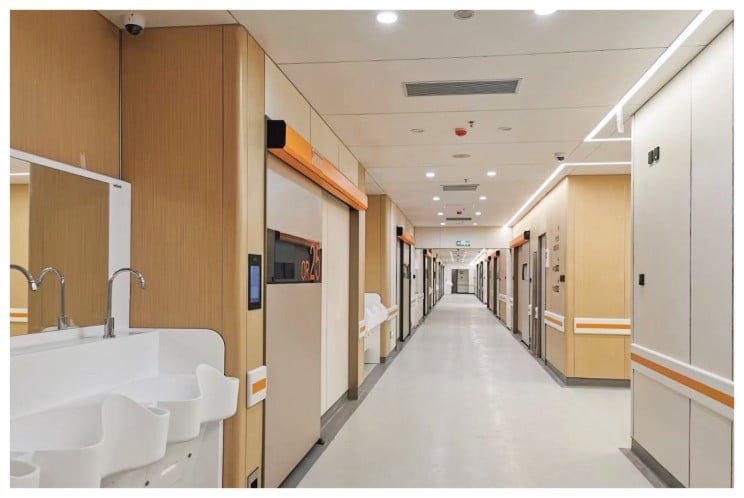
The number one worry for cleanrooms is particle contamination. Whether in the operating room or the pharmaceutical or semiconductor production room, even minute pieces can ruin products, affect patient health and safety, or compromise research efforts. The first line of defense is Fan Filter Units (FFUs) which will draw air through HEPA or ULPA filters and provide clean, dust-free air to the cleanroom. But without FFUs it cannot accomplish the task. The role of clean room windows in the prevention of particle contamination is very supportive but not an essential component. Poorly designed, installed or maintained windows are sources or pathways of particles. Here are four ways that clean room windows help to keep contamination out of a clean room with the help of FFUs.
1. Sealed Perimeters Block Particle Entry from Adjacent Spaces
The FFUs generate either negative or positive air pressure areas in the clean room. In a positively pressurized room, clean air escapes through any opening. In a negatively pressurized room, unfiltered air from adjacent spaces enters through openings. In either case, a poorly sealed window edge will turn into a particle route.In either case, a leaky window edge will turn into a particle route.
Seals between the clean room window frame and the window panel should be continuous and should be compression tested. Closed-cell EPDM or silicone gaskets are used in Huaao windows to fill in the minute irregularities on the surface of the window. The pressure difference that is common in an FFU system (10 Pa to 250 Pa) will be maintained by the sealing system. Air leakage testing according to GB/T 7106 or ISO 13830 is a test to ensure that each window complies with leakage rates of less than 0.5 m³/h at 50 Pa. Huaao can provide double-seal configuration in critical applications such as pharmaceutical clean rooms, ISO Class 5. These seals prevent particles from passing through any perimeter openings, ensuring that any particles remaining in the room have passed through an FFU filter.
2. Non-Particle-Shedding Materials Eliminate Internal Sources
Particles can be produced by the window if the perimeter is closed. Fibers tend to pop off of rough surfaces. Aluminum is not coated and it oxidizes and flakes. Gaskets will crumble if not properly finished. The particles are most harmful when they are generated inside the clean boundary as they are referred to as internally generated particles.
Huaao cleanroom windows are manufactured from materials selected for low particle generation.Frames are powder coated aluminum with an electrostatic epoxy or polyester finish which are resistant to chipping, flaking and oxidation. There are no particles generated by wiping the surface (abrasion particles: RA < 0.8 μm). No raw edges on glass, edges are tempered or laminated and are polished. Silicone or Viton is used for gaskets which will not outgas or be degraded by UV or chemical attack. These materials are necessary, not optional, when there are airborne particle counts (ISO Class 3 to Class 5) required in the FFU cleanroom.
3. Flush Profiles Prevent Particle Accumulation Zones
It gets rid of accumulation zones with flush-mounted windows. The glass is flush with the rest of the cleanroom panel. No ledges, steps or crevices. Huaao's flush windows combine into a single flush surface which is easy to wipe in one stroke. Flush profiles are additionally effective for flushing particles out of the system in FFU systems having laminar airflow. Instead, particles are smoothly swept towards return grilles, and out of the cleanroom.
4. Condensation Resistance Prevents Microbial Growth
Condensation is not only a moisture problem, it's a particle problem. The water droplets on the window surface are able to capture particles from the air. These wetted particles over time provide a means for microbial development. Biofilms form, and particles can be created by fragments of the biofilms, which can grow more as bacteria and fungi grow. Microbial contamination is a risk factor in pharmaceutical cleanrooms which may result in rejection of a batch and shut down of a cleanroom.
Huaao's anti-condensation windows (double glazed with Low-E coating and thermal break frames) ensure that the inside glass surfaces are above the dew point of the room air. In high-airflow FFU rooms, where forced convection is more efficient at transferring heat to the window, the window still remains dry. If the conditions are very severe, the heated glass choices give an active prevention of condensation. As a result of eliminating condensation, Huaao windows eliminate one of the main avenues for increased particle build up and microbial amplification.
Summary
There are four ways that the clean room windows block particle contamination in the FFU systems: first, the clean room window perimeters are sealed to prevent particles from entering from other rooms; second, it's non-particle-shedding material, which removes the particles that can be produced inside the clean room; third, the windows have flush profiles to eliminate particle accumulation zones; and fourth, the windows are condensation resistant to prevent the growth of microbes. These windows are part of a full one-stop system for clean room construction that is provided by Huaao Clean Technology Group, which has 250,000 m² of total production lines, with 6 factories, 800 workers and total annual revenue of 1 billion RMB, a national high-tech enterprise. To discuss windows with Huaao, which will actively help your FFU contamination control strategy, contact Huaao today.
